Welcome!

My business is to provide people the opportunity to sample the exciting and challenging fishing available at the southern end of Lake Michigan. This page is dedicated to showing a bit of the behind-the-scenes work it takes to do that and to highlight the trips and fun my customers are able to experience.

Friday, July 11, 2014

FIGHTING FLEAS

   I don’t particularly like invasive species. Many are downright bad for the environment. A few have turned out to be interesting if not welcome additions to the outdoor world. Most are just “there” and either don’t bother much, are a mixed blessing or at least they don’t bother me much.

  Not so the  Cercopagis pengoi, other wise known as the fish hook flea.  Often when my lines are clogged with the almost microscopic animals there’s another “F” word used ahead of the name fish hook flea.
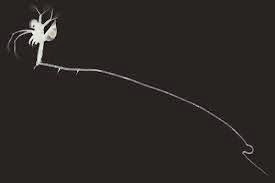
   Think of these little zooplanktons as tiny scorpions swimming in the water. As your fishing line drags through the water, especially lines pulled deep by downriggers, their up-turned “scorpion tail,” the fish hook that grows at the end of their tail for which they are named, snags on the fishing line.

   Indeed the little invasives from Southwest Asia are tiny. Having one on your line would go completely unnoticed. Having a million of them clinging to a hundred feet of line would hardly be noticed and probably not cause much grief to fishermen. But drag a thin fishing line through the flea-choked waters of Lake Michigan in July and August when the flea-bloom is going full-tilt and it’s not millions or probably even billions of them clinging to a 100 feet of line. It may be trillions.

  In 20 to 30 minutes you line goes from being a thin thread dragging through the water to a quarter-inch-thick rope. Try to reel it in and there’s trouble. Try to reel it in with a fish on the line and it’s hectic and frustrating trouble.

   When the line is reeled, the FHFs clog at the tip guide of the fishing rod. At first, the line slides through the clog but as more line is reeled, the clog gets bigger and tighter, eventually gripping the line so tight no more line can be gained by cranking the reel.

   The fleas can be manually removed, but a good clog may take up to a minute to clean up. Then reel in another 20 or 30 feet, then stop and start flea-picking again. As I said, its annoying at best, and frustrating when there’s a salmon or trout on the line, hopefully hooked good enough that it’s not going to lose the hook while you are messing with the FHF.

   There are solutions. They aren’t good, but it sure beats putting up with the fleas. Some guys swear by Cortland Line's Flea Flicker Line and I've no doubt it works. It’s a flat line instead of round. Usually, having a bit of a twist in the line isn’t a good thing. With the Flea Flicker line, it won’t work without having some twist in it. If a flea hits the flat side, it bounces off. If it hits the narrow edge, they will hook on, but the water pressure on them as they are towed along by the line causes them to slide down the line and when they rotate around the twisted line they just unhook and float away.

    Just as effective (and less expensive) for me is to switch to heavier line.  Usually, spooling a top-shot of 30# mono on the 'rigger rods does the trick. The line is thick enough the "hook" on the flea-tails won't grab on. Last year, the fleas must have been larger and I had to move to #40.
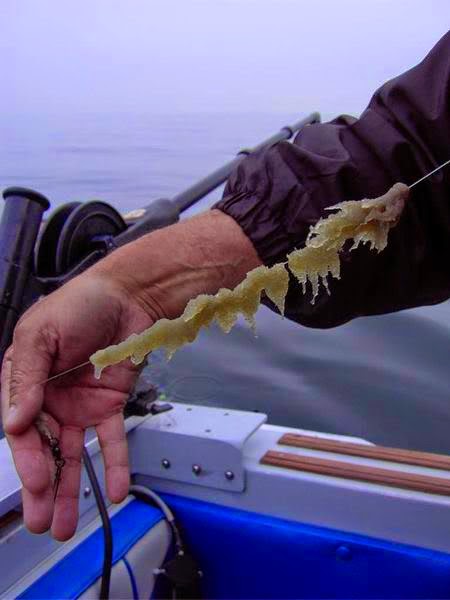
How many millions do you suspect
are in this typical clump of fleas? 

   I only spool 150 feet on each reel so a quarter pound spool will easily do all my ‘rigger reels for a couple years. That length will easily go from the rod tip to the downrigger release at the depths I commonly run my lures.

   Connect the heavy line to the lighter line with a double uni knot (go to www.netknots.com).  I add a 20# fluorocarbon leader to any of the lines which will be pulling spoons, again with a double uni. If I'm using a dodger or flasher, I just tie direct.

 The downside to this is the increased water resistance of the thick line pulling through the water increases the sway-back of downrigger weights. With braid, I can hit the bottom in 100 feet of water by letting out around 110 feet of downrigger wire. When using 30# mono, it will easily take 130 feet or more, depending on how fast I’m trolling.

   It’s not as much fun to catch a fish on long lengths of stretch mono, either. The choice are pick fleas or catch fish. I’ll go with catching the fish.

Wednesday, June 11, 2014

GRAMPA'S ADVICE

Conditions can be frigid in the spring. 
  Each customer I take out on Lake Michigan gets either an email from me or a letter through the regular mail that gives them directions to the marina, advice such as “don’t forget sun screen,” and other tidbits of information. Among the tidbits is a saying I learned from my dad who was quoting my great grandfather, a man of whom I have only scant remembrance.
 
  Grampa Charlie’s advice is, “It’s better to have it and not need it than to need it and not have it.”  Wise words and none better when figuring what kind of clothing to choose for a day on Lake Michigan.

Conditions can be tropical in the summer. 
  One of the advantages of fishing on the Brother Nature is it’s open and roomy for fishermen. One of the disadvantages is the same, especially the “open” part. If it’s sunny, you’ll be in the sun. If it’s cold you’ll be in the cold.  So dress accordingly. And dress for the time of day you’ll be out there.

  If the high is predicted to be 90 degrees, light clothing is all you’ll need. However, if we are leaving the dock at dawn and it will only be 65 degrees at that time, you are going to be chilly in a tee-shirt and shorts.

  Don’t forget the lake affect, either. Ninety degrees on land doesn’t mean 90 degrees if we are 15 miles offshore in 64 degree surface water. If there’s much of a breeze, the on-board temperature may not exceed lower 70s all day.


So plan it out and tote it along.  I do, everyday. I might have only a scant memory of my ol’ grampa Charlie, but I remember his words. “It’s better to have it and not need it than to need it and not have it.”

Monday, June 9, 2014

GREAT FISHING, TWO WAYS

The weather forecast was for waves “about a foot” for last Friday and Saturday. On Lake Michigan that can have waves over 20 feet high during gales, “about a foot” is a great forecast.

Luckily, much of our early season fishing is nearshore where even if the evil winds are blowing, we can tuck in behind industrial breakwalls or stay nearshore where the seas will be kinder. But come summer, often it’s offshore 10 miles or more or nothing, so a calm mid-lake forecast is like a kiss from a pretty girl.

The forecast for Friday and Saturday was off by about 8 inches. The waves never got over four inches!  Back to back, flat calm conditions are exceedingly rare.

 The odd thing is how different the fishing was on those two days.

This is what the lake looked like as we were motoring to the fishing area on both Friday and Saturday mornings. You can see how majestically beautiful it was just after sunrise and it stayed that way all day, both days.

And on Friday, the fish loved it! The first fish bit while I was setting the third rod. A magnificent lake trout, Lake Michigan’s native apex predator came to the net. Then another and another and another and.... In short order, we had our laker limits and I pushed our trolling speed up, switched to lures more conducive to catching steelhead or salmon and the lakers continued to slurp up our baits. We did have one steelhead bite, but it threw the hook on it’s second aerial display.

I figured the next day was a slam dunk. No weather changes, I knew where the fish were, another great weather day. Ah, but the fish gods weren’t smiling!

This is my "should have been here yesterday crew" from Saturday. These guys are smiling because of the weather but what you see is the total catch. Three (nice) trout and one decent steelhead. We had a few other bites but a fish not caught is not counted for the most part.

As the sayings go, "that's why it's called fishing, not catching," or "the fishing was great, the catching was slow," or "A bad day of fishing is better than a good day at work."

So both days were successful, but in different ways. The saga of the Brother Nature continues.....

Saturday, May 24, 2014

LUCKY SHOT

 I have lots of experience in taking fish photos. They are called “hero shots” where the lucky angler who has caught a photo-worthy fish stands, gripping and grinning, fish in hand and the photo is snapped.


   Most hero shots look, well they look contrived. Sure it’s a lasting tribute to both fish and angler of the size of the fish and the smiling face of the fisher-person. On the other hand, it’s a picture of a mope with a dead fish-or nearly dead.

   Professional photographers leave little to luck. They understand what’s going on. They prepare the scene, adjust the lighting and leave little to chance. Amateurs rely on luck.

    I’m somewhere in-between. I don’t rely on my photography skills to earn much money each year, but plenty of my photos end up in print. Sometimes a bit of luck helps out even us “semi-pros.”

   This was one of those times.

   Liz caught a nice lake trout on my boat and she handed her dad the camera to do the classic “grip and grin” photo. Since we were in the “photo” mood, I grabbed my own camera to take a happy-snappy of my own.

   The first time I pressed the button, the fish, still lively, waggled a wiggle. In the tiny view screen on the digital, I could see the fish wasn’t properly displayed. So I told Liz to hold it up once more for another shot. She complied.
  
Back at home, downloading the photos from the camera to the computer and able to see the photos in large size instead of a tiny LCR on the back of the camera, I realized Lady Luck had given me a blessing.

   The second photo showed a bored young lady with an apparently dead fish and an apparently fake smile staring at the lens.  The first photo, however, showed a beautiful young lady with a real smile coping with a lively fish.  A million times better in my book! Don’t you think so, as well?

Friday, March 28, 2014

PLANK IT!

Trim up the filets
Plank and Grill
Customers often ask me the best way to cook the salmon they are catching. I tell them,  “Remember in the movie, Forest Gump, when Bubba and Gump were scrubbing the floor with toothbrushes and Bubba started listing all the ways to cook shrimp? It’s like that with salmon. You can fry it, bake it, broil it....”
 
Another way is to “plank” it. The result is a marriage of smoked salmon (delicious) and grilled salmon, equally delicious.
 
Grilling planks are available in many places. Bass Pro Shops and Cabela’s have them, or get them on-line from Amazon.com.

The idea is simple. Lay the fish on the plank instead of just on the grill rack. Then lay the plank on the grill rack, shut the lid on the grill and let it cook.

There are some preparatory chores before the final cooking. First, soak the plank in water. Cedar (the most popular plank) is a soft wood and will ignite easily. You do want the plank to burn eventually, but not instantly. Submerge the plank in a shallow pan of water for several hours.

I like to keep my grilled salmon simple so all I use is a bit of Lawry’s Seasoned Salt as a rub. If you have a favorite such as lemon pepper or other seasoning, have at it.  Once I have the filets trimmed, skinned and all the pin bones removed, I give it a light dusting of Lawry’s, top and bottom, pat the salt onto the meat and put in the refrigerator for an hour.

Don't expect leftovers!
Take the soaked plank from the water, rub a bit of cooking oil on one side then arrange the fish on the plank. I add a bit of fresh or dried dill to pep it up a bit. Then put the plank over the hottest part of the grill.

The plank will deflect most of the heat, preventing the fish from cooking too quickly. The wet wood resists burning because it’s wet. In essence, this initial cooking phase steams the fish.

Ideally, about halfway through the cooking process, the plank will dry to the point it starts to smolder and produce smoke. This is the smoke flavoring part of the cooking process.

Once the plank starts to smolder, turn down the heat and let the fish finish cooking slowly. Total cooking time is roughly 15 minutes. Don’t overcook. Remove the fish to a serving platter, douse the plank to put it out and dinner is served.


Saturday, February 15, 2014

GREAT LAKES ARE FROZEN

 As of mid-February, all five of the Great Lakes are “officially” frozen over.  In actuality, they were 90% ice covered, but when they hit that level, the people in charge of observing Great Lakes ice conditions proclaim them to be totally frozen. The last time the lakes were frozen completely was in 1994.

        Few lakes in the upper Midwest completely freeze in the winter. Springs, muskrats, wildfowl, stream inflows, pressure ridges and other factors often produce areas with thin ice or even open water.

          In the Great Lakes, unfrozen areas can be the result of currents as in the Straights of Mackinaw, St. Mary's River, Detroit River, Niagara River and a few others. Industries and lake shore power plants discharge heated water in other areas. There can be wind-driven openings in the ice similar to pressure ridges that occur on inland lakes.


      The U.S. Coast Guard operates a fleet of ice-breaker vessels on the Great Lakes. There's our tax dollars at work!  In some areas tug boats and other vessels do ice breaker duty to keep industrial harbors in action.

        There are two silver linings to the frozen Great Lakes. Winter evaporation from unfrozen surface water in mild winters is one factor creating what’s become chronic, even record low lake levels. Related to the evaporation from the unfrozen lakes is, once the lakes are frozen, the lake effect snow machine is shut down. The upper Midwest is getting enough snow to satisfy most people without the lake snow this winter.

       Will this have an affect on the fishing next season?  Maybe a late start to the action.... Maybe it will drive more fish down to MY end of the lake.... Hope so! There's only one way to find out. The fun way.  Let's go fishing !

Sunday, September 29, 2013

GEAR GRABBER

I first saw the Gear Grabbar (no misspelling) at the inaugural Chicagoland Fishing, Travel and Outdoor Expo last winter.  “Just another lure organizing tool,” I thought to myself. When Jennifer Gesik, sales director, demonstrated the Gear Grabbar, I thought, “Wow, it may just be another gear organizing tool, but it’s a cool one.”

I’ve used similar things in the past. Some were chunks of foam fastened in a strategic location. Others were shallow trays to contain stray hooks and tackle or little ledges with holes to poke hooks to keep lures in check. It was just as easy to put a lure back in the tackle box as in the temporary hook-holder.

So what makes the Gear Grabbar different? Magnets! And more.

The more is the aluminum bodied Gear

Grabbar is configured similar to a piece of angle iron. Mount the GG so the back part of the angle is against the mounting surface, the other part of the angle is like a shelf with the imbedded magnets facing down. Mounting is simple with two-sided sticky-tape dots (included) or by fastening to the backing with stainless steel screws or bolts.

Jennifer Gesik, the GG-Girl
When you take out a lure, or take it off the line, it’s simple to just slap it up under the GG and it sticks. The magnets are so powerful, you can throw the lure at it and the hooks will stick. When they are stuck under the ledge, they are much less likely to catch on pants, shirts or worse, skin, if you accidently brush against the GG.

I ran into Jennifer again recently at an outdoor writer’s gathering. I verbally gave her a testimonial about how much I liked the Gear Grabbar on the boat and picked up couple more, as well. I will be putting them somewhere.  Available in black or white, look for them at Cabela’s, Bass Pro and other tackle shops or at www.magneticmarineproducts.com .